MENU

Increase and Historical Trends of Minimum Wage in the Philippines

On September 18, 2025, the Philippine Department of Labor and Employment (DOLE) issued a directive to raise the minimum wage in Cebu (Class A, Region VII) by 39 pesos, increasing it from 501 pesos to 540 pesos, effective October 4, 2025.
The current minimum wages in the Philippines’ major cities (Manila, Cebu, Davao) are as follows:
- Manila (NCR): Non‑agriculture ₱695 / Agriculture and others ₱658. Wage Order NCR‑26, effective July 18, 2025.
- Cebu (Central Visayas): Class A ₱540 / Class B ₱500. Wage Order ROVII‑26, effective October 4, 2025.
- Davao (Region XI): Non‑agriculture ₱510 / Agriculture ₱505. Wage Order RB XI‑23, effective March 7, 2025.
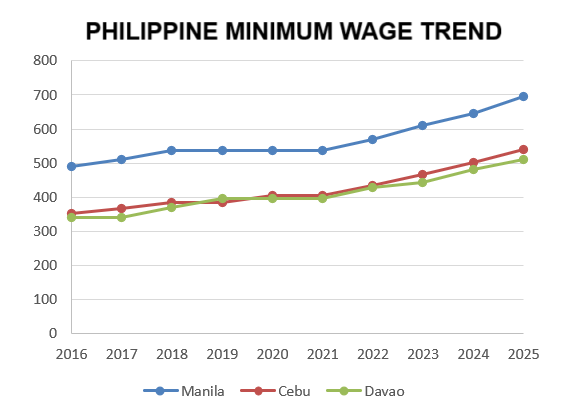
Minimum wage trends in major Philippine cities (Manila, Cebu, Davao) (2016–2025)
In the Philippines, minimum wages are set by region and are gradually revised in line with economic growth and inflation. According to the latest directive, as of 2025, the minimum wage for the non‑agriculture sector is ₱695 in Manila (NCR), ₱540 in Cebu (Central Visayas, Class A), and ₱510 in Davao (Region XI). All are based on the most recent wage orders effective in 2025.
Over the 10 years from 2016 to 2025, Manila’s minimum wage increased from ₱491 to ₱695, a rise of approximately 42%, maintaining the highest level nationwide. Cebu’s minimum wage rose from ₱353 to ₱540, an increase of about 53%, and Davao’s from ₱340 to ₱510, up roughly 50%, reflecting gradual wage increases across all regions.
In recent years, revisions have become more frequent to keep pace with high inflation and rising living costs. For businesses, it is important to accurately track regional minimum wages and update salary tables and employment contracts according to the latest standards. The graph below allows for a clear comparison of the trends over the past 10 years.
- Regarding the Philippine withholding tax certificate (BIR Form 2316)
- EOPT (Ease of Paying Taxes Act) Law and Its Impact on Accounting and Tax Practices in the Philippines
Related Articles
-
 Overview of Health and Medical Insurance in the Philippines and Contribution Rates
 -
[Latest Edition] A Complete Guide to Applying for the Japan-Philippines Tax Treaty
-
EOPT (Ease of Paying Taxes Act) Law and Its Impact on Accounting and Tax Practices in the Philippines
-
Regarding the Philippine withholding tax certificate (BIR Form 2316)